Your dog isn't being bad. He's panicking.
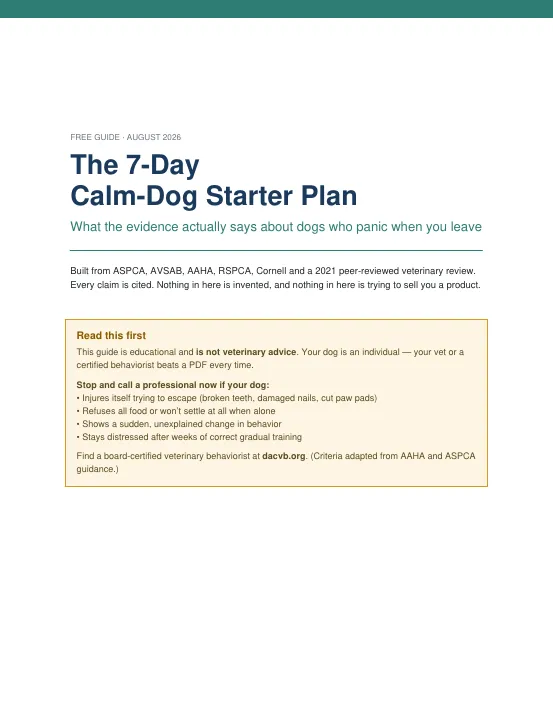
A free 7-day starter plan for dogs who bark, chew or fall apart the moment you leave — built from ASPCA, AVSAB and peer-reviewed veterinary sources. Every claim cited. Nothing invented.
No spam. Unsubscribe in one click. We'll also send you a short series on what the research actually says about separation anxiety.
If any of this sounds like your evening, this guide was written for you.
- You've come home to a chewed door frame — and felt angry, then guilty.
- Your neighbor has "mentioned the barking" more than once.
- You've cancelled plans because you can't face what happens when you leave.
- Someone told you that you spoiled him. You've been carrying that around.
That last one isn't true, by the way. A 2021 review in the Journal of the American Veterinary Medical Association looked for evidence that spoiling causes separation anxiety and reported plainly: it isn't there.
What's in the 7-day plan
- The video test that veterinary behavior services actually require for diagnosis — and what to look for in the footage
- Day 2's "keys" exercise: why your dog panics before you've even opened the door, and the cheapest fix in this guide
- The food test on Day 3 that tells you whether you're dealing with a mild case or something that needs a professional
- The one rule of graduated departures that almost everyone breaks — and the two time thresholds (40 and 90 minutes) that mark real progress
- Four things that never help, each one documented: punishment, shock collars, "cry it out," and being "the alpha"
- When to stop DIY and exactly who to call
Why this is different from the other free PDFs
We don't own a training method to sell you. This guide is a plain-English synthesis of what ASPCA, AVSAB, AAHA, RSPCA, Cornell and a 2021 JAVMA review publish — with a source table at the end so you can check every claim yourself.
It also tells you where the experts disagree (there's a popular tip about ignoring your dog before you leave that the research does not back up), and it tells you when a free PDF stops being enough.
This guide is educational and is not veterinary advice. If your dog is injuring himself, refusing food, or in acute distress, contact your veterinarian or a board-certified veterinary behaviorist (dacvb.org).
Get the plan — free
No spam. Unsubscribe in one click. We'll also send you a short series on what the research actually says about separation anxiety.